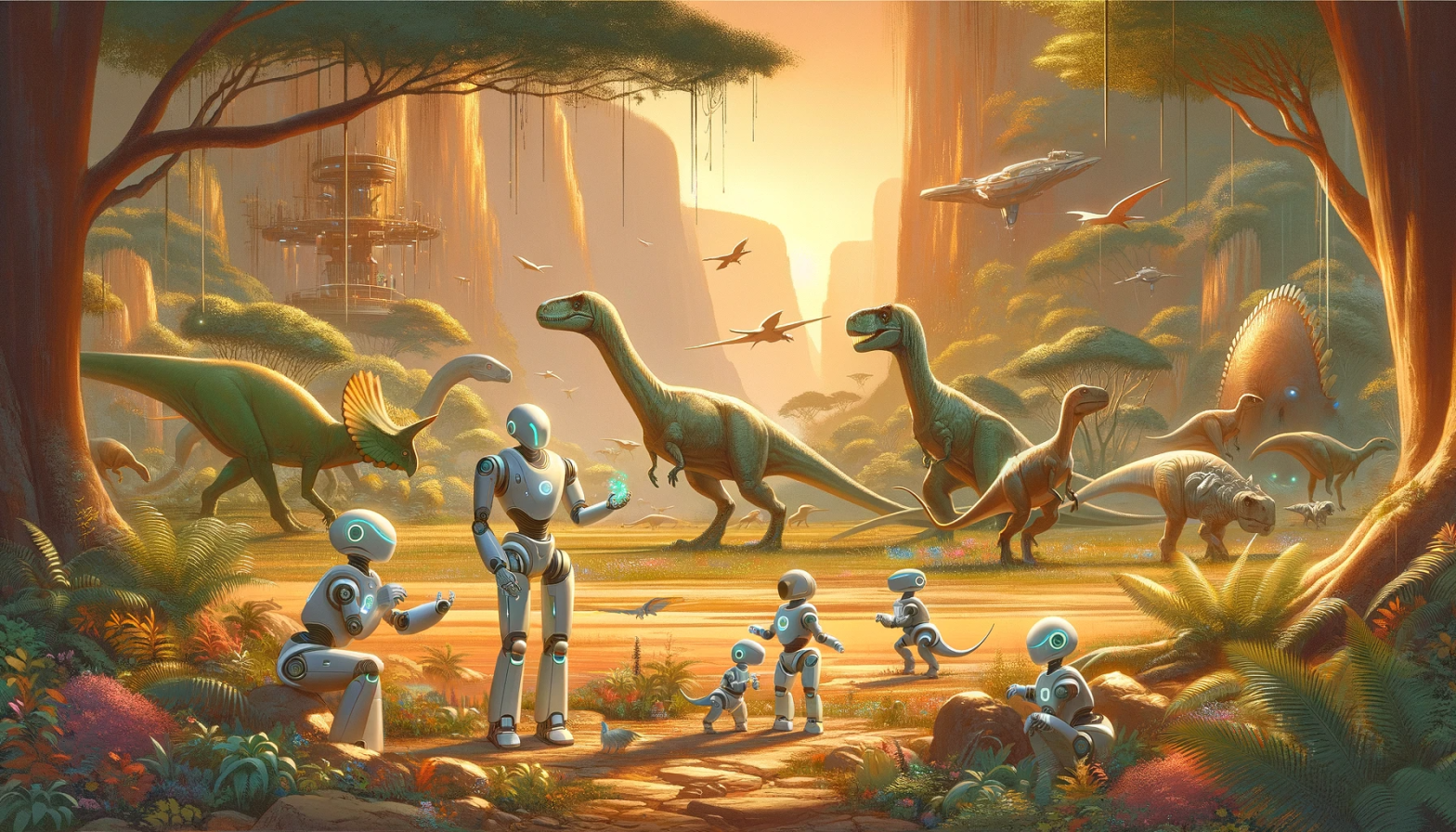
Those who know me know I love “Jurassic Park.” I have since I was a kid. Part of my fascination was the dinosaurs. What kid doesn’t have a favorite dinosaur?! (Mine’s the triceratops since you’re asking.)
They didn’t scare me. In fact, my grandmother always said when I turned the movie on, I would say, “You can sit next to me; I’ll protect you if you get scared.”
The other reason for my love of the movie was the “what if” possibility so much of the movie represents. What if we could recreate DNA to resurrect extinct species? It was almost like time travel. Around the same time, Dolly the sheep had been cloned, so it was also being heavily discussed in school.
It’s no surprise that changes to technology will always be fascinating to me. That’s why teachers must be using AI, not only to reduce their stress, fill in gaps in their ability and increase quality for their students, but also just to stay with the times and prepare their students for the world ahead.
Recently, I was listening to the “Jurassic Park” and “Lost World” audiobooks by Michael Crichton and, if you’ve never read these books, you should. The books are wildly different, but much more on the nose with the big point: Technology is amazing, but you have to be wary of the ramifications that come with it.
Crichton — an M.D. from Harvard — was not, however, anti-technology. In book after book, Crichton demonstrates the power of technology progressing. In “State of Fear,” he shows how technology can be used to understand and address climate change problems. “Sphere” and “Timeline” explore the ideas of space exploration and time travel. “The Andromeda Strain” describes an effort to use science and technology to address a deadly, extraterrestrial microorganism.
While Crichton is famous for his warnings about hubris, control over humans, manipulating nature, climate change, and social isolation, he never blamed the technology, flora or fauna for their part in his sci-fi problems — he blamed humans for not thinking enough about the technology around them.
Technology was never the villain. People were. Crichton only wrote about dinosaurs, but he wasn’t one — and you shouldn’t be either.
OUT WITH THE OLD

In a scene from the “Jurassic Park” book, Dr. Ian Malcom discusses nature’s general ability to adapt despite challenges.
“Life breaks free,” he said. “Life expands to new territories. Painfully, perhaps even dangerously. But life finds a way.”
All life, including nature, embraces technology.
Chimps use sticks to pull termites from mounds, rocks to crack open nuts, and leaves to scoop water. Crows and ravens also use sticks and have been shown to drop nuts onto roads for cars to crack open. Dolphins use sea sponges while foraging to prevent abrasions on their noses.
Sea otters use rocks to crack open shellfish. Octopuses have been seen carrying coconut shells and other objects as mobile predator defense shelters. Elephants (my favorite living mammal for those keeping track) often use branches and sticks to swat flies, scratch an itch, and even dig for water in dry riverbeds.
Humans just do it more. Technology isn’t a violation of “what nature intended,” but exactly what was meant to happen. Life finds the path of least resistance.
Humanity has a funny habit of creating brilliant technology, bashing said technology, slowly integrate it into our everyday lives, and then complain about how hard we once had to work (and complain, again, about when it’s not there).
Renown philosophers Socrates and Plato hated the written word because it would “create forgetfulness in the learners’ souls, because they will not use their memories.” When newspapers came around, a French statesman argued they socially isolated readers and detracted from the spiritually uplifting group practice of getting news from the pulpit.
Radio would supposedly destroy intellect by “distracting children from reading and diminishing performance in school.” Media historian Ellen Wartella notes “opponents voiced concerns about how television might hurt radio, conversation, reading, and the patterns of family living and result in the further vulgarization of American culture.”
The internet caused a wave of new fears. A few headlines — each citing exploratory experiments — that have not aged well include “Emails ‘hurt ID more than pot,’” “Facebook and MySpace generation ‘cannot form relationships,’” and “Is Google making us stupid?”
It’s true. Every new technology has a bad first date with humanity because we have some serious trust issues. We barely trust other humans, much less a robot made by one. That leads to headlines like “Artificial intelligence and messaging prove a bad mix for relationships.”
IN WITH THE NEW

The first step in embracing AI is to accept its existence. As a journalist, I’m forced to painfully watch community newspapers around the country die because editors felt like a newfangled thing called The Internet was “just a fad” (a real quote). The industry was too slow to react.
The issue was a reluctance to give up the old ways for the sake of nostalgia. There are issues, absolutely. But to advocate abstaining from a new, better, more efficient tool simply because “that’s not how we’ve always done it” is absurd.
In case you need to hear it: Artificial intelligence isn’t going anywhere.
AI will be a ubiquitous part of daily life for people in the next decade. People will “ask ChatGPT” the way we tell people to “Google it” now. According to Reuters, ChatGPT currently has more than 180 million users, which is 80% growth over just an eight-month period.
Schools are meant to be foundries that produce people ready to enter the real world: college, career, the Armed Forces, or whatever else they decide. All of those are already using AI, so why wouldn’t we?
There’s no reason. Teachers should use AI to make their job more informed, efficient and stress-free. Students should be trained to use AI ethically and responsibly, spot AI-generated content, and understand how to use it as a tool their every day life without being dependent upon it.
In an EdWeek article, one California superintendent wrote: “Schools will need to engage in deep discussions of what students should know and be able to do in the new era of AI. I think AI will push making education more relevant to the individual student, and the knowledge and skill they will need to transact with their life circumstances.”
Let’s be real: It’s not just a good idea to use AI; it ought to be a requirement.
WHERE DO WE GO FROM HERE?
A high school principal commented in the same EdWeek article that “since AI is not going away, we need to rethink assessment methods and find ways to harness the power rather than shunning it.”
Teachers have to be more street smart than the students they teach. They have to know what the technology is, how students are going to use it, and spot it when it’s being used irresponsibly or to cheat.
Yes, students will cheat using AI. Though, it’s no different than going online and paying someone to do the work now, or even just borrowing an essay from a friend from a previous year, or using an app to run math equations.
It’s going to happen. It’s the school’s job to be ready to spot it and to teach students to use the power for good.
A couple of examples where students can utilize AI to help their own success:
- Any student could use AI to be a personal tutor — customizing their learning independently. Problem-areas could be explained, content rephrased or translated, or written as a metaphor to learn the content through high-interest areas. Sometimes we get gifted students slowed down by the class setting. AI can help them get ahead.
- Students in our school often struggle with transitioning to the real world. They may be unsure of how job applications work, confused on words in college applications, or unaware of the best practices for a job interview. AI chatbots can be the first line of help.
There are, to be sure, potential problems for teachers and students to fall onto practices of using AI as a crutch. This is where we come in as educators to teach them how this is problematic and the proper way to utilize artificial intelligence and avoid its pitfalls.
I’ll end with another quote that aged poorly — one from Malcolm in “Jurassic Park” when he describes how the internet will destroy intellectual diversity: “It’s disappearing faster than trees. But we haven’t figured that out, so now we’re planning to put 5 billion people together in cyberspace. … Everyone will think the same thing at the same time.”
That didn’t happen and will never happen. The human brain cannot be replicated, but our human experience can be made better with better tools. That’s all AI is.
To ignore new tools like generative AI will be a surefire ticket for someone to be the next exhibit at “Jurassic Park” and we all saw how that ended.
 Green's J-School