All teachers need to be using AI

Those who know me know I love “Jurassic Park.” I have since I was a kid. Part of my fascination was the dinosaurs. What kid doesn’t have a favorite dinosaur?! (Mine’s the triceratops since you’re asking.)

They didn’t scare me. In fact, my grandmother always said when I turned the movie on, I would say, “You can sit next to me; I’ll protect you if you get scared.”

The other reason for my love of the movie was the “what if” possibility so much of the movie represents. What if we could recreate DNA to resurrect extinct species? It was almost like time travel. Around the same time, Dolly the sheep had been cloned, so it was also being heavily discussed in school.

Photo by DALL-E

It’s no surprise that changes to technology will always be fascinating to me. That’s why teachers must be using AI, not only to reduce their stress, fill in gaps in their ability and increase quality for their students, but also just to stay with the times and prepare their students for the world ahead.

Recently, I was listening to the “Jurassic Park” and “Lost World” audiobooks by Michael Crichton and, if you’ve never read these books, you should. The books are wildly different, but much more on the nose with the big point: Technology is amazing, but you have to be wary of the ramifications that come with it.

Crichton — an M.D. from Harvard — was not, however, anti-technology. In book after book, Crichton demonstrates the power of technology progressing. In “State of Fear,” he shows how technology can be used to understand and address climate change problems. “Sphere” and “Timeline” explore the ideas of space exploration and time travel. “The Andromeda Strain” describes an effort to use science and technology to address a deadly, extraterrestrial microorganism.

While Crichton is famous for his warnings about hubris, control over humans, manipulating nature, climate change, and social isolation, he never blamed the technology, flora or fauna for their part in his sci-fi problems — he blamed humans for not thinking enough about the technology around them.

Technology was never the villain. People were. Crichton only wrote about dinosaurs, but he wasn’t one — and you shouldn’t be either.

OUT WITH THE OLD

DALL-E’s interpretation of Malcom’s quote.

In a scene from the “Jurassic Park” book, Dr. Ian Malcom discusses nature’s general ability to adapt despite challenges.

“Life breaks free,” he said. “Life expands to new territories. Painfully, perhaps even dangerously. But life finds a way.”

All life, including nature, embraces technology.

Chimps use sticks to pull termites from mounds, rocks to crack open nuts, and leaves to scoop water. Crows and ravens also use sticks and have been shown to drop nuts onto roads for cars to crack open. Dolphins use sea sponges while foraging to prevent abrasions on their noses.

Sea otters use rocks to crack open shellfish. Octopuses have been seen carrying coconut shells and other objects as mobile predator defense shelters. Elephants (my favorite living mammal for those keeping track) often use branches and sticks to swat flies, scratch an itch, and even dig for water in dry riverbeds.

Humans just do it more. Technology isn’t a violation of “what nature intended,” but exactly what was meant to happen. Life finds the path of least resistance.

Humanity has a funny habit of creating brilliant technology, bashing said technology, slowly integrate it into our everyday lives, and then complain about how hard we once had to work (and complain, again, about when it’s not there).

Renown philosophers Socrates and Plato hated the written word because it would “create forgetfulness in the learners’ souls, because they will not use their memories.” When newspapers came around, a French statesman argued they socially isolated readers and detracted from the spiritually uplifting group practice of getting news from the pulpit.

Radio would supposedly destroy intellect by “distracting children from reading and diminishing performance in school.” Media historian Ellen Wartella notes “opponents voiced concerns about how television might hurt radio, conversation, reading, and the patterns of family living and result in the further vulgarization of American culture.”

The internet caused a wave of new fears. A few headlines — each citing exploratory experiments — that have not aged well include “Emails ‘hurt ID more than pot,’” “Facebook and MySpace generation ‘cannot form relationships,’” and “Is Google making us stupid?”

It’s true. Every new technology has a bad first date with humanity because we have some serious trust issues. We barely trust other humans, much less a robot made by one. That leads to headlines like “Artificial intelligence and messaging prove a bad mix for relationships.”

IN WITH THE NEW

Image: DALL-E

The first step in embracing AI is to accept its existence. As a journalist, I’m forced to painfully watch community newspapers around the country die because editors felt like a newfangled thing called The Internet was “just a fad” (a real quote). The industry was too slow to react.

The issue was a reluctance to give up the old ways for the sake of nostalgia. There are issues, absolutely. But to advocate abstaining from a new, better, more efficient tool simply because “that’s not how we’ve always done it” is absurd.

In case you need to hear it: Artificial intelligence isn’t going anywhere.

AI will be a ubiquitous part of daily life for people in the next decade. People will “ask ChatGPT” the way we tell people to “Google it” now. According to Reuters, ChatGPT currently has more than 180 million users, which is 80% growth over just an eight-month period.

Schools are meant to be foundries that produce people ready to enter the real world: college, career, the Armed Forces, or whatever else they decide. All of those are already using AI, so why wouldn’t we?

There’s no reason. Teachers should use AI to make their job more informed, efficient and stress-free. Students should be trained to use AI ethically and responsibly, spot AI-generated content, and understand how to use it as a tool their every day life without being dependent upon it.

In an EdWeek article, one California superintendent wrote: “Schools will need to engage in deep discussions of what students should know and be able to do in the new era of AI. I think AI will push making education more relevant to the individual student, and the knowledge and skill they will need to transact with their life circumstances.”

Let’s be real: It’s not just a good idea to use AI; it ought to be a requirement.

WHERE DO WE GO FROM HERE?

Image: DALL-E

A high school principal commented in the same EdWeek article that “since AI is not going away, we need to rethink assessment methods and find ways to harness the power rather than shunning it.”

Teachers have to be more street smart than the students they teach. They have to know what the technology is, how students are going to use it, and spot it when it’s being used irresponsibly or to cheat.

Yes, students will cheat using AI. Though, it’s no different than going online and paying someone to do the work now, or even just borrowing an essay from a friend from a previous year, or using an app to run math equations.

It’s going to happen. It’s the school’s job to be ready to spot it and to teach students to use the power for good.

A couple of examples where students can utilize AI to help their own success:

  • Any student could use AI to be a personal tutor — customizing their learning independently. Problem-areas could be explained, content rephrased or translated, or written as a metaphor to learn the content through high-interest areas. Sometimes we get gifted students slowed down by the class setting. AI can help them get ahead.
  • Students in our school often struggle with transitioning to the real world. They may be unsure of how job applications work, confused on words in college applications, or unaware of the best practices for a job interview. AI chatbots can be the first line of help.

There are, to be sure, potential problems for teachers and students to fall onto practices of using AI as a crutch. This is where we come in as educators to teach them how this is problematic and the proper way to utilize artificial intelligence and avoid its pitfalls.

I’ll end with another quote that aged poorly — one from Malcolm in “Jurassic Park” when he describes how the internet will destroy intellectual diversity: “It’s disappearing faster than trees. But we haven’t figured that out, so now we’re planning to put 5 billion people together in cyberspace. … Everyone will think the same thing at the same time.”

That didn’t happen and will never happen. The human brain cannot be replicated, but our human experience can be made better with better tools. That’s all AI is.

To ignore new tools like generative AI will be a surefire ticket for someone to be the next exhibit at “Jurassic Park” and we all saw how that ended.
Q&A with Student Journalists

One of the first things I tell my students when they start my photojournalism course is: “This is not just taking a picture.”

Anyone can hit the shutter release. Operating a DSLR with skill and then editing those photos, is MUCH harder than anyone realizes. Take the difficulty of that, combined with moving images, audio, and uncooperative lighting: boom, you have videography.

Completing this task was more arduous than the others because the videos had to be shot in person. Compared to a written story or podcast, which could be done remotely. However, the combination of back-to-school events, an unexpected illness, and – why not – jury duty, left me scrambling to complete a video shoot in time.

I mention this because it is a good reminder to advisers that students stress to complete our work on top of five to seven other classes, and life. Think about that when you assign a project and they’re slightly late. These students are capable of producing professional level work, but lack the professional time dedicated to doing it.

The biggest hurdles were lighting, equipment and audio.

Because I chose a Q&A format of a story (I tend to lean toward more features and people-heavy stories), the chief characters had to be lit well and nicely positioned. While I used a studio light to add some light on the subjects, I forgot to look at the background and, in post, realized I didn’t block out the windows, leaving a distracting and back-lit background.

In terms of equipment, shooting the b-roll was simple using an iPhone 12 Pro Max. The interviews were slightly different. Despite my best attempts, it just wasn’t working. Partially because I didn’t have a phone stand and constant emails from work would ruin the video and audio. So, I gave in and used a DSLR from then on out because I’m a perfectionist. In the field, the phone would have been perfectly adequate, but the specific situation called for the upgrade.

Finally, I lacked an audio device and had to use the built-in audio recorder. In hindsight, I would have gone to the A/V tech teacher and borrowed a lav mic. This made their audio very low. In Adobe Premiere, I duplicated the sound levels and stacked them on top of each other – a trick my professor taught me to boost sound levels without as much hiss. It still ended up a bit garbled at points, but acceptable nonetheless.

For teachers, take the risk. Make your kids go out and shoot video. Tell stories through quick interviews, b-roll and take the readers there.

Just make sure they shoot horizontally.

The editors of the Caney Creek Student Media program discuss their experiences and growth as student journalists, and explain why others should join as well. Video & Produced by Stephen Green

Loom provides nice screen recording solution to teach journalism concepts

When the pandemic struck in early 2020, I was at a loss for how to teach students such a hands-on topic like journalism, design and photography. Someone, who is now lost to history, was wise enough to lead me onto Loom – a free screen recording software.

Loom has many other competitors in the screen recording world, but there is a few reasons I like Loom compared to others. First, it stores videos in the cloud and allows me to embed video links similarly to YouTube as I have done below. This is a tutorial on how to operate our school newspaper website I made for students new to adding social media elements to the website.

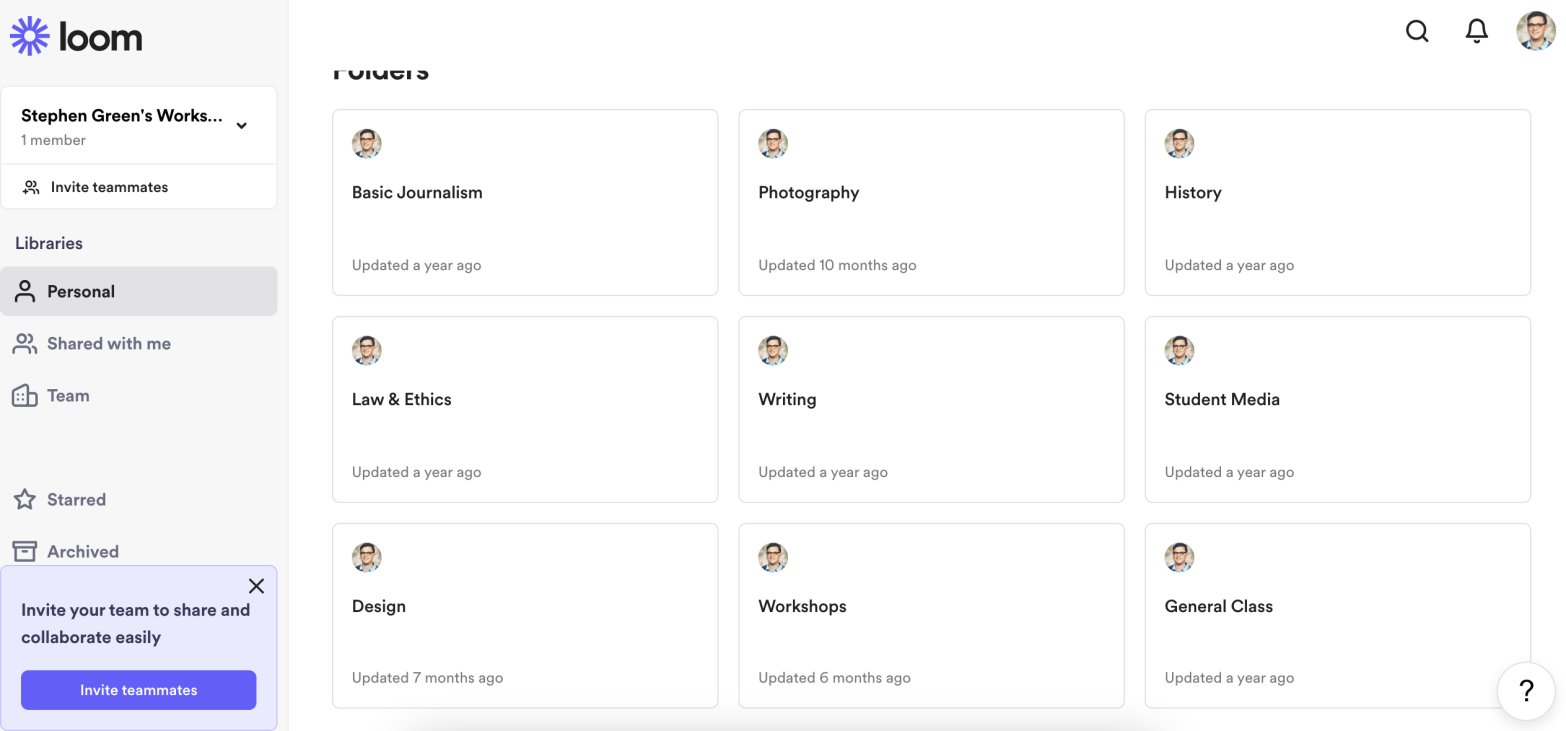
Additionally, Loom allows me to download actual video files if I need those, as well as lets me organize my videos into folders that helps when I’m looking to use tutorials on photo editing, writing, history of journalism, ethics, etc.

Students particularly have fun when they can react with emojis while watching the videos when they like, don’t understand, or otherwise have a reaction to something said in the video.

Another pro is the ability to record the screen and with my camera at the same time. I didn’t in the video above because there wasn’t a need. However, it is an option available, as well as making videos private when you don’t want the general public to see videos like when I show my Student Media staff how to log into the website.

This is also helpful when you need to demonstrate technology needs that is easier to show than type. For example, I used it to record a 15 second clip showing a student how to create a new folder in Google Drive. There was no editing, exporting or texting needed. Just record and send the link.

The downside is no editing. I can’t go back and edit the videos unless I download them, which becomes a burden if you are halfway through a video and goof up. You have to startover or do video editing later.

The lack of video editing is nice because it saves time, but doesn’t allow me to adjust audio levels, cut out unneeded parts, or splice in stills when it might be advantageous.

Interview podcasting: when gab isn’t the gift

Knowing when to cut down banter proves a tough challenge in audio recording

The most recent episode of Green Around the Quills, I hosted my first guest: Leigh Anne Treistman, my coworker and newest adviser to Caney Creek Student Media. As an adviser out of her first full year of experience, she had a fresh take on what she could have done better and what works well.

Equipment, Software and Challenges

We recorded the interview in an empty classroom at our school after the second day of school using an iPhone 12 Pro Max. To cut down on background noise, we chose a location away from vents and covered the phone with a cloth before recording that helps cut down on pops and other quieter, distracting noises.

In post, I chose to use Adobe Audition to edit, which proved to be a quick and efficient choice. This was especially helpful because Treistman was farther from the phone than I was. As a result, she was much quieter than I was, which resulted in having to do more nuanced edits to raise her voice but not mine.

The audio levels for hers needed to be raised about +6Db whereas mine actually needed to be lowered at times. For her, this caused some hissing where the white noise of the background was amplified, and mine sounds muffled at parts.

Time

Although this was recorded for a grad school class, I wanted to potentially continue this podcast and needed to exceed the 10 minute time limit to retain much of the conversation we had.

Treistman and I can talk for hours as we are both passionate about this subject. As a result, I had to find moments in the interview to either shut down the conversation to move on to another question, ask a follow up to go more in depth, or jump back to a topic I forgot to address earlier in the interview.

One tip that I retained from my undergrad (frankly, just from muscle memory) is to not audibly respond or acknowledge her answers like you normally would in a regular conversation. Instead, I would nod my head to show I was hearing her answer so I wouldn’t “step” on her answers.

Not interjecting made editing in post SO much easier when there were lots of “ums” and “uhs”. I left some in because otherwise the conversation felt less natural and almost sterile.

Theme

Finally, because I can’t help but have consistency, I chose to use the same music, intro style and outro style so that the branding stayed intact. The same is true for the imaging, which I used Canva for and just changed out the episode information before uploading to SoundCloud, which was a pretty painless process overall.

Making a podcast: Green Around the Quills

Creating podcast proves to be engaging, fun challenge

As a freshman at Sam Houston State University, I knew I was dead set on being a print journalist. In high school, I was editor of the school paper and jumped into the college newspaper The Houstonian before my first day of classes.

The longer school went on, the more I realized that there was more to journalism than ink and newsprint. Journalists had to provide content in the form people want.

Now, enter the podcast. Ever since NPR’s “Serial” broke the podcast into the mainstream, anyone with a microphone and opinions seems to have their own show. This isn’t to say the market is oversaturated (although that can be debated), but that podcasts are obviously here to stay and wanted.

At our Student Media camp two weeks ago, I was talking about how our big goal this year was to beef up our online presence. Examples of some of the things we could do as a staff I provided included video interviews, interactive infographics and, yes, a podcast.

About four students immediately perked up and said, “We can do that?” I said, “If you want to do it, we will.”

We have a meeting this week to decide what the podcast will be and how to put it together.

Testing, testing

Before I can assist my students, I need to go through the process of creating a podcast myself. Luckily, the Kent State program provided the perfect timing for this. I needed to create a podcast about any topic related to scholastic media.

There is such a thing as paralysis of choice. So, as I also tell my students, I chose a topic I know a lot about, which helped to write a script quickly, give a natural delivery, and even go off script a little when something came up naturally.

My podcast was thus created: Green Around the Quills, a podcast designed to help beginner advisers navigate the world of scholastic journalism. My first episode, tips for interviewing, came straight from a universal problem every adviser deals with and one I am all too familiar with as a former professional, collegiate and scholastic journalist that focused on reporting.

This is the end result:

What to use?

Not having the need before, my equipment was limited. But, as a professor once told me, the news waits for no one so work with what you’ve got. In my case, that is an iPhone 12 Pro Max and a sock.

My undergrad included several classes on audio production including my own radio show and stories on the radio newscast. One lesson we dealt with because of limited equipment was to use a sock on your microphone to cut down on background noise.

So, I locked myself away in the office with a sock around my phone, tested the audio and read the script.

The script proved difficult because my writing can be a bit verbose, which audio journalism has no time for. I found myself 15 minutes in before the script was done. There was no choice but to attack the script with a machete and hack away until I was down to five minutes. I decided that beginner advisers, many of whom do not have professional journalism backgrounds, might be better served with interviewing tips that help my students most rather than activities and deep explanations of why everything works.

After it was all said and done, I popped the audio into Adobe Premiere, cut out the pops and mistakes, and exported to an MP3 before uploading to SoundCloud. To make the account look more professional, I used Canva’s free templates to create a photo and added royalty-free music from incompetech.com to make the podcast feel a bit more intentional than me in my pajamas talking to my phone.

Thinking ahead

In all, the process went smoothly. To improve the podcast, there are three things I would change for the next time: interviews, hardware and software, and feedback.

First, my voice is about as exciting as Ben Stein reading a tax return. Just like kids in a classroom, you don’t want to only hear from the teacher non-stop for 50 minutes. Having a diverse set of voices would make the product more engaging.

Next, I would use a software designed for audio editing like Adobe Audition (as I am an Adobe fan) or an open-source editing software like Audacity. Using Premiere was a requirement of the course, but, frankly, overcomplicates the exporting and editing process. However, if you are already familiar with Premiere and not Audition, the editing can absolutely be done on there.

The other part of the editing/recording process that needed improvement would have been having a soundproof area (although the sock helped enough) and a good microphone to record with to reduce hissing, pops, background noise and control the echo.

Lastly, the whole experience is meant to help people. It would have been nice to be able to create a podcast to address a specific need and not a need that I think people have. Audience engagement is important to make people feel like they are part of the production process and keep them coming back for more.

In with the old, in with the new

Mobile world isn’t killing journalism, but presenting new form

“When I was a kid…”, then insert some reminiscence about the limitations of television channels, only having radio, or the ear-splitting squelch of dial up internet.

“Back in my day…”

Generation after generation the world has supposedly gotten worse with the invention of every new version of mass communication…at least if you asked those prior generations. Younger generations embrace and make the new medium what it is.

In the era of mobile journalism, you can still see the same core tenants of what makes the news, news: these are the news values.

“…we only had the newspaper and radio.”

The printing press was the grandaddy of all mass media, according to Inside Reporting Chapter 1. The industrial and interchangeable-type version of Chinese block printing took literacy to the masses since manuscripts were no longer the only way to access information.

Newspapers dominated what was then called journalism because there was no other competition medium. That is, until radio enters the scene.

From there, newspapers fight for reader attention because not only a boom in newspaper competition and the penny press making production cheaper, but also radio journalism giving readers news more immediately. Yellow journalism enters the scene. The news became flashier and appealed to more lurid senses.

A distaste for this style of news and oversaturation allowed the more modern journalistic style to break through thanks to the work of the New York Times. From the 1900s until the 1950s, radio and newspapers shared the journalism spotlight and had a lock on gatekeeping.

“…we only had three channels to choose from.”

When the news not only could be brought into the living room audibly but also visually, the game changed yet again.

The John F. Kennedy/Richard Nixon debate, the JFK assassination and Vietnam War cemented television as the new “it” medium and the nightly news became a kingmaker. Networks dismantled the morning newspaper as the only source of news and the newspapers had to pivot.

Television would have one more change in the 1980s when Ted Turner had an idea for a 24/7 television station delivering nothing but news. Some said it wouldn’t work, but 9/11 proved there an undeniable desire for people to watch the news unfold.

“…we only had dial-up internet.”

After print, radio and TV came the newest juggernaut: the internet. From dial-up and web logs to fiber internet and social media, the internet brought the world to the palm of readers hands.

The internet made all three of its ancestral media way underplay what was coming down the pike. Now, it is the dominate choice of news for most people.

“Yeah, but Buzzfeed and Huffington Post is just a bunch of cat videos and useless quizzes.”

Somewhat true, hypothetical critic. However, cat videos are just as much newsworthy as a change to city ordinances. Just not in the same way. Why? The customer is always right.

According to Inside Reporting’s Chapter 2, news values are universal and have been used throughout the history you just read through.

Newspapers might have started by also including who served tea at the Rotary luncheon, but it was local. Radio brought home World War I because it had impact. Television news showed us interviews with celebrities because they had prominence. Cable news brought us the play-by-play of Baby Jessica because it was unique. The internet brings us feel-good stories and, yes, cat videos because they have human interest. These news values will never go away, just change shape.

All of them also brought readers news about elections, tax increases and social movements because people also cared about those. Thus, news values are as true in the age of mobile journalism today as they were with every new technology before.

Most importantly today, mobile journalism destroyed the gatekeeper. Now, the only one preventing individuals from seeing the news is themselves. Information is there at the ready, especially if news organizations utilize the natural way people took to mobile life.

Mobile devices also allow people to engage with news makers, be the news makers, and get information provided by news makers instantly from anywhere without needing to wait for the next morning newspaper, radio show, nightly news or cable box.

Mobile journalism is not only here to stay, it is ultimately the next logical evolution of journalism just as every generation before it had and ought to be embraced.

Mobile journalism creates potential golden age of journalism

The Great Thing of Power

The height of beauty, knowledge and power – nothing says more about social media and the digital realm more than J. R. R. Tolkien’s description of the elves.

In the movie adaptations of “The Lord of the Rings: Fellowship of the Ring”, Galadriel – queen of one of the elven realms – delivers a profound monologue about vital, lost history.

“The world is changed,” she says. “I feel it in the water. I feel it in the earth. I smell it in the air. Much that once was is lost, for none now live who remember it.”

If we were to translate this into talking about news platforms, most people my age and older think that this quote would be addressing the supposed death of print media. Leigh Anne Treistman, who also teaches journalism, is still an ardent supporter of newspapers but can’t find one that will even deliver to her home anymore.

Sunday is a heavier news day because I might read on my phone but go pick up a copy of a paper New York Times if I can find one. And if it’s a huge news event I see on phone, like who won the election, I read the headline but then run out early to grab the papers I want to keep.

Leigh Anne Treistman

Now she, and five others I spoke with, primarily get their news from news apps on their phone or from news-oriented social media like Twitter and Reddit.

“News is part of my daily routine – early morning prior to work is a heavy news time for me,” she said. “I follow several news reports and journalists too, so I check those accounts. During the day – all day between class change and lunch. I use news to teach from, so articles are a big part of reading for work.”

Sure, print media is taking a nosedive. Even those that usurped the newspaper as the kingmaker (TV and radio) are in the middle of a battle against its fiercest foe yet: the internet. More people than ever are glued to their pocket computers absorbing and exuding information at rates so powerful, smartphone addiction is a real problem.

Rebecca Green said she stays on her phone almost all day into late at night and basically all but ignores news unless a notification grabs her attention.

“Usually I get headline notifications from a few sources,” she said. “If I’m interested I read it, if not I delete it.”

But this is not the end of journalism. To repeat Galadriel, the world is changing.

ONE THING TO RULE THEM ALL

News will never die but change form as people will always need to know what is happening around them. The new digital world combines all former media platforms into one that travels with readers.

Newspapers are the best example of an industry, among others, that turned its back on the internet as a fad rather than jumping en masse into a new way to present the information. The moral of the story today is that modern journalists must stay flexible and mobile.

The rise of the smartphone in the mid-2000s compressed a roomful of devices into anyone’s pocket. Much like Kodak’s camera that made everyone a photographer, everyone can now be a journalist of their own lives. 

ONE THING TO FIND THEM

Social media, in my view, became a natural extension of that human nature. The technological advancements now let them connect with others first in text, then images, then audio and video. Most young people now get their news from the internet and social media.

People are not only consuming this information, but are active researchers and creators. Gone are the days of the publication gatekeeper of information (a new one has entered the mix) and content generation. Hanging onto the old ways of doing the news is just nostalgia for nostalgia’s sake. The discussion should turn from “how do we get people to tune in/pick up the paper?” to “how can we give people high-quality news in a form attractive to them?”

ONE THING TO BRING THEM ALL, AND IN THE DARKNESS, BIND THEM

This is the mobile-first journalism approach in a nutshell. Journalists must know how to write, take photos, record audio and video, then edit and upload. They must have people generate content for them to leverage citizen witnesses. The mobile, or backpack, journalist also must know how to research from their phones as well. 

All of this must be done with the platform and audience in mind. Creating a story to be posted on Instagram Stories or TikTok is wildly different than a traditional Instagram post or Facebook link. The audience could be geographic, demographic or interest-based. Having a fundamental misunderstanding of either the platform or the audience results in a round-peg-square-hole situation.

The kids call it “cringy”. 

In other words, the news organization is using a platform in a way disconnected from the audience or connects with the wrong audience on the wrong platform. It’s easy to see this type of pandering, which will only result in the media outlet becoming the butt of the joke rather than actually informing people.

Moving forward, the digital landscape will change yet again – just ask chatrooms, blogs, Google+, Vine, MySpace, and other social media or internet-based platforms that have gone the way of the dodo. 

This is how students must learn to use the technology they are native to, combined with ethical storytelling skills, to become the new face of journalism.

Harnessing the power of the digital environment and new ways people communicate is how journalism goes from the cliche dying industry to the most powerful industry with more ways of delivering content than ever before.

What is the difference between a good and bad quote?

One of the core tenants of journalism is providing a voice for the voiceless. The majority of our readers are not in power and have no inherent way to change the world by themselves. The media provides those people, the vast majority, a place to have their voice heard. Let’s make it count.

Here’s the problem: Kids suck at asking questions and giving answers.

For some reason, their natural curiosity and drive falls apart when learning journalism techniques because they think that interviewing for a publication is somehow wildly different than having a plain conversation, which leads us to good, juicy quotes.

My own students struggle with identifying the good quotes not only in the moment of the interview, but in the writing stage when choosing what goes in the final story. This is what I coach my writers on.

1. Does it have emotion?

The only real reason to include people is to provide color, the emotional side of the news. Theoretically, journalists could write entire stories every time without quotes. Our job is simply to collect and then distribute information. But, that’s boring. Readers don’t want boring. Compare these two quotes.

“I think the dance was great.”

“I danced so much I literally fainted. That DJ was fire and had everyone bouncing.”

Only the second gives me an accurate impression of how the dance made people feel. Sure, the first gives me their opinion. But if all we have are six interviews that say the dance was great/OK/so-so/awful, and nothing else, it’s going to disinterest readers and they’ll bail out.

Great news organizations include emotion both to keep readers interested, but also for the reasons that follow.

2. Does it help a reader understand why the story matters?

But that doesn’t always help the reader understand WHY a story matters. Take this fictional story for example:

The Cityville ISD School Board unanimously passed a new proposal last night, purchasing ramps that will make the football stadium more accessible.

“The ramps will be placed so that handicapped attendees can sit along the front row,” Board President John Q. Public said.

There’s nothing wrong with that story in terms of information. We all know what happened, but the general reaction would be an inglorious shrug.

Instead, use quotes that get to the heart of why we should care that the board bought ramps.

The Cityville ISD School Board unanimously passed a new proposal last night, purchasing ramps that will make the football stadium more accessible.

“My son has played soccer for four years and I’ve had to watch from a corner,” CHS parent Jane Smith said. “With these ramps, I’ll finally be able to watch him do what he loves where he can see me, too. I’m just so happy; I’ve cried all day.”

Everyone understands that feeling of wanting to do something but not being able to. The emotion is what is relatable, not the board president’s comment that tip-toes around the big impact here. Sure, you might include him at some point, but his comment should add to the other, more impactful dialogue.

3. Does it paint a picture you didn’t see as a reporter?

Journalists should absolutely use their own eyeballs as eyewitness testimony in a story. You don’t have to attribute “the sky was blackened by a thick, acrid smoke that roiled out of the exploded petrochemical refinery” if you saw it. However, if you weren’t there, the fewer firsthand details you can include.

Quotes can be that source of description for people that weren’t there.

“We were eating dinner when we heard a bang so loud, I thought one of our guns went off. It shattered a window and knocked pictures off the walls. It wasn’t until about an hour later that we realized it was from the plant blowing up.”

Even if, as writer/reporters, we want to stretch our literary legs a bit when crafting a visually compelling story, sometimes it’s good to take a break and let the audience do it for us with quotes like that. Ask the interviewee to describe the scene, mood, tone, visual elements, etc. of the scene and then you have not only one more potential reader, but also compelling quotes that give readers not there a sense of how the story felt.

4. Could you have said it?

A good question to ask yourself. There is no intellectual property rights to facts. For example, there’s nothing stopping you from rewriting all the tips on this page and using it in a classroom setting. So, why does that apply here?

Quotes should not be a resuscitation of fact. It goes along with choosing quotes that are emotional, but is important enough to have its own section. Many times, fact-based quotes can be rewritten into paraphrased sentences to transition. Most people speak in patterns of giving you some fact, then their opinion on it. For example:

John Smith: We had to close the school due to the flood. I never thought water would get in. It rose so fast, we could barely make it upstairs, much less save the furniture.

The first line of Smith’s quote is really a fact, which makes for a boring quote and, assuming that’s what the article is about, it’s sort of a “duh” statement. Plus, as a journalist, you can factually write that. The second sentence is sort of dry because it is a throwaway opinion. However, rewrite that second sentence as a paraprased quote to transition to the real, meatier quote, which is the last sentence. Example:

John Smith said he never thought water would get in.

“It rose so fast, we could barely make it upstairs, much less save the furniture,” Smith said.

It’s short, sweet and much more entertaining than direct quoting all three sentences.

Students haven’t gotten those solid quotes? Make them go out and get more. Keep talking to people, re-talking to them and pushing with better questions until they do.

5. Does it reflect diverse points of view?

The student publications are, well, for students. Sure, teachers and administrators will read them, but the kids are the ones you really want excited about it. It’s the whole point really no matter what end goal you look at. There’s one sure-fire way to get people excited about a product: seeing themselves in it.

Here’s the thing, though, we have to come to grips with the fact that we tend to interview the same people over and over and over again ad nauseum. My students are, inexplicably, enamored by the fact they can interview the district superintendent and he actually answer. So he, and the principal, get interviewed for everything. But you have to get different points of view including:

  • Alternative Opinions: Sometimes there is an issue that many people agree with, but a smaller group disagrees for various reasons. These should be included, within reason, to provide as many different world views as possible. In addition, it helps a reporter keep their bias in check by making sure that the quotes they have don’t accidentally weight the story in favor of the view they have. Sometimes students come from backgrounds where parents do not ever discuss alternative viewpoints, so they take their opinion as fact.
  • Race/ethnicity: Different cultures and experiences from every racial and ethnic group provides some potentially worthwhile, and many times vital, perspective.
  • Sex/gender/sexuality: Men, women, and those on the gender spectrum all have their own set of unique issues that add value to stories and coverage.
  • Political: Students have a wide and … interesting … set of political opinions, many times uninformed. Presenting them with alternative viewpoints can be good in widening their own perspective on political issues.
  • Religion: One often overlooked demographic in journalism is religion. However, religion plays a major role in almost every aspect of life. Don’t ignore it.
  • Adults vs. students: While students may be tempted to only talk to adults, or only talk to students, all of them are part of the school community. They get a say, too.
  • Popular vs. the unknown students: Just because the football captain gets interviewed all the time doesn’t mean you can’t talk to the kicker or lineman.

The list above is by FAR not exhaustive, but they are perspectives quotes can provide.

Hot tip: Do a retrospective look at your publication from the year before. Who got quoted a lot? What stories aren’t being told? What groups at our school are left out? Who goes to school here? Are we leaving some voices out of the debate? Are certain people being left out in the cold? How can we include those people?

This is NOT to say you should have a quota of types of people per story. However, representation matters. It is one way to get people turned off of the publication if we only hear from the same people over and over again.

6. Is it something only that person could have said?

The best, truly best in my opinion, quotes are ones that are unique to that person and that story. The phrase, “I couldn’t have made it up if I tried,” comes to mind.

Not every quote is going to be wildly bizarre or filled with compelling emotion. However, we can avoid the trite soundbites that get recited on cue, as if by training.

You know them:

  • We tried our hardest.
  • We went out on the field and gave it everything we had.
  • We worked well as a team.
  • I had a lot of fun.
  • It was good.
  • I liked it.
  • I’m excited for X to happen.

Borrriiiiiinnnngggggggggggggggggggggggggggg.

Sure, they have an opinion. They happen to share it with millions of other people. Coooolllll. Where’s the emotion?!

Why did you try hard? What were you thinking on the field last night when you first stepped onto the grass? What are things you do as a team to bond? Why was it fun? Why was it good? What about it did you like? What makes you excited?

Simply asking the “why” question about 506,000 times to a person makes them come up with something. They are usually not used to being asked what they think and, as a result, give an answer that’s about the same.

You want THEIR story. The one about that they only got into debate because their uncle was. About how they have to Uber to work because their family can’t afford a car. The story about overcoming a disability no one knew they had. Those are the things that make quotes special.

In sum, I want quotes that engage me, make me happy/sad/angry/disappointed/excited, make me want to do something, entertain me. It should make me want to hear more of the story, not fill the gap from point A to point B.

7. Does someone else in the story already say that?

If so, don’t use it.

If Johnny says he “doesn’t like the cafeteria food,” then Janie says “the cafeteria food really just isn’t for me,” then Lillian says “the food here is whack,” what did I really learn? Nothing after Johnny’s quote. Janie and Lillian, as sweet as I’m sure they are, added nothing to my story. It’s not their fault, it is the reporter’s. Read over copy and make sure each quote provides something new, something fresh.

I am a new adviser and afraid: 5 pieces of advice

After my first year as a teacher, I was asked to take over the journalism program at my school. I had about 160-ish days of experience with teenagers teaching world geography and communication applications, both courses where students had no choice but to attend.

Have something you want advice on? Fill out this form!

As a former journalist who went into education with the goal of teaching journalism, I was beyond ecstatic. I immediately accepted with no conditions whatsoever. I would have taken a pay cut to get the job. All that to say the pent-up excitement bursting forth.

Then came moving-in day. I pushed my metal cart down the hall, banging against the floor and wobbling from the weight of books and supplies that I admittedly overloaded. I walked into my new classroom, full of ideas. Then, nothing.

My mind screamed, “What’s next, moron?” I had no plan for curriculum, staff nor knowledge of the administrative ropes of scholastic journalism. Real journalism was easy. Reporting inside a school had its legal and ethical quandaries I had never experienced.

Whether you’re a seasoned educator or newly minted in the world of education, being thrust into the world of scholastic journalism is simultaneously terrifying, overwhelming and thrilling. Let me be one of the first to say: You’ll be OK.

As someone who still remembers and has survived the hurdles of a first-year adviser of any student publication, here are my tips for surviving that first year. Some you might have seen in other places, but are nonetheless true.

Tip 1: Come to terms with the fact you’re a team of one

With the exception of larger schools, you will likely be on your own. This means coming up with lesson plans, prepping materials, working with staffers, problem solving, navigating budgets and administrative hurdles, all while being the only one in the room.

Most everyone else, perhaps you included, have never had student publication experience. Just know that’s OK.

For time immemorial, new journalism advisers have been in the same boat. I have had no one on campus to help me understand a concept I didn’t fully understand, or know how to translate an idea to a lesson, or rely on when I am sick to help pick up the slack with administrative tasks. It is a burden.

Coming to grips with this now will help you cope in the future. There is no denying it is a tough, complicated, maddening, frustrating job. However, as I will note, it will be one of the most rewarding endeavors you will ever have in your life.

Tip 2: Understand the material & be honest about what you don’t know

Students know a teacher who doesn’t know what they teach. It becomes apparent to students so fast, you won’t realize you’ve lost their confidence before they’re long gone.

These hormonal monsters we come to love are smarter than society proclaims them to be. They can sniff out insecurity and fakeness like a bloodhound. They might not be able to have proper subject-verb agreement, but they are socially observant.

To remedy this, there are two primary cures: learn and be honest.

As a teacher, you should want to know more about your content anyway. Teachers that don’t strive to be learners themselves should not expect their students to want to be either. However, more than the ethical reasons, understanding what journalism is will make editing, coaching and advising so much more easier. Similarly, not knowing how to teach or create lessons will render your students maddened by messy lessons or you frustrated by lack of student understanding.

Regardless of your background, be honest with the students about your experience with journalism and/or education going in. While they can spot insecurity from a mile off, they also appreciate honesty. The first speech I ever gave my class was very close to the following: “OK, y’all. Here’s the thing: I know what I’m doing. I was a journalist for a long time in school and as a job. What I don’t know is how I’m going to teach you. Things might get confusing, frustrating and complicated for both of us. However, we’re going to figure it out together. I’m not going to get mad at you for my mistakes. I just ask for understanding and patience while I work things out.”

Students respect teachers that don’t pretend to be high and mighty. So don’t act like it.

Tip 3: Set one, realistic, worthwhile goal

Two weeks into my first journalism 1 class, I had covered news values, ethics, lede writing, news story structures, and set my students off on a venture to write a story. With a feather in my cap, I started marching toward my desk. On a hunch, I asked the student if they had any questions. One, reading the instructions and looking perplexed, asked, “What is a news story?”

It was obvious I went too fast.

My expectation was to charge in head first, with my journalism experience behind me, carving out the next Woodward and Bernstein, ready to take on the world. Instead, I had a class, half-full of Ferris Buellers who caught about 1.5% of what I said.

While having a world-class journalism program is absolutely a worth-while goal, don’t expect it on year one. It is simply unrealistic and achievable. You’ll deal with a staff that doesn’t know you or your expectations. You will be weaving the ropes of teaching a complicated craft. You’ll be strained under the pressures of deadlines, money and quality.

Pick one thing you want to do that year and nail it. It doesn’t really matter what it is. Some possible goals include:

  • I’m going to meet all my deadlines this year
  • All my senior photographers will be able to shoot in manual
  • The yearbook/newspaper will make its budget
  • Students will understand the basic story formats
  • I will have a staff of at least (X number)
  • I will focus on story/photo/design quality this year

Setting realistic goals will lower the pressure and make life easier for you mentally.

Tip 4: Ask for help

We can’t expect our students to ask for help when they don’t understand something if we don’t do the same. Something I had a hard time coming to grips with: I can’t do it alone.

We already established you will (most likely) be alone in your process of teaching future journalists. However, that’s only on your campus. The world of journalism advising is refreshingly full of engaging, knowledgeable and friendly people who will share, give and assist at the drop of a hat. They’ll send lesson plans, critique your publication and give guidance on crises that evolve throughout the year. (Be assured they will occur.)

Some groups you might want to join:

Swallow your pride and ask about what you don’t know. People are willing to donate time, materials and even equipment if you ask. The worst they can say is no.

Tip 5: Have fun

Ask any long-time adviser. The one thing that keeps many in the field is the students. You are the yearbook lady/guy. You are the photo teacher. You are the newspaper adviser. You are the promised land for the most ecclectic group of students on campus.

If you build a report with students and have let the fun occur within reason, it is worth every long night, tear-filled conference period, and anxiety riddled night.

Journalism is hard. You have to be a combination writer, reporter, editor, designer, photographer, marketer, business person, accountant, social media influencer, expert in everything, and so much more. You are one of the only jobs protected in the Constitution. That’s astonishing and a profound responsibility. But that’s all the more reason to let your hair down and enjoy the ride. I’m still working on that myself.

On my birthday, which I have never really celebrated as it isn’t that special of an event for me, my students surprised me with a cake, hats, and a generally good time. I never told them my birthday was coming up, what kind of cake I like, nor that I wanted anything. In fact, most kids were surprised to learn of my birthday after the fact. But I was touched. My yearbook staff all wore green (in honor of my last name) and cardigans (a fashion statement I am known for as most other male teachers don’t don them) en masse. These are the students who won’t participate in school spirit days, but they’ll honor me. Wow.

You are their person. You’re a confidante, counselor, educator, business leader, editor, publisher, teacher, administrator, enforcer, and so much more. But to the kids, you make their day better.

Don’t forget that and enjoy it.

How do I take my photographer from just OK to amazing?

When school started, a third-year photographer in my yearbook program pulled me aside and said, “What do I need to do to be a great photographer?”

It confused me because she was already producing stellar work when compared to her peers. She captured lots of emotion, had fantastic composition and could coach other photographers to do the same.

Why did she feel that way? She was seeing all of this award-winning feature photos and saw other schools doing well in competition. She simply reached the plateau I had not had a photographer reach yet. She was doing everything right, but needed a push to the next level.

I set off on a quest to collect information from those more in the know than myself. My background was in writing rather than photography, and many other first-time advisers will eventually feel this loss for advice.

Below is a sample of advice taken from the Association of Texas Photography Instructor’s Facebook group, as well as a few professional photographer friends:

  • Take lots of photos. Digital photography lets us take hundreds or thousands of frames on one card. Do it. Like any skill, photography requires practice. The more situations you encounter, the more modes and settings you try, and the more you think about what your work lacks, the better it will get.
  • Force yourself to try new angles. One adviser says to try three different angles for every normal shot you get. As a photographer for the local newspaper says, “Once you have your CYA shots, play around. … Your feature photos are what sets you apart from everyone else.”
  • Relax and do not overthink the photos. Some of us will occasionally get too in our head trying to think, think, and think some more and get a bit of paralysis. Take the approach of writers with writer’s block. They write through it; photographers should shoot through it. Photography should be fun and exciting. Maybe taking a step back to let your hair down is time well spent.
  • Think about the photos. Now running to the other side of the spectrum, some photographers just hold that shutter release and puts no thought into the message they’re trying to convey. Ask them what their photos say. What’s the point of it? What story does it tell? Making them think some more can help them see the world differently.
  • Look at other photography. With social media and the entirety of the internet, there is zero excuse for photographers not to be looking at other work. Writers read other work. Athletes study plays and strategies. Teachers attend professional development. Photographers should study other photographers doing excellent work. Create a Twitter list of amazing photojournalists and other photographers. Look them up on Instagram. Make students evaluate each other’s work. Getting inspiration from history and peers is a sure-fire way to bolster their skills.
  • Tell stories. Photojournalists have one goal: let people know what happened. Anyone with a camera phone can take a snapshot of what something looks like, but what did it feel like? How did people act and react? What colors and textures were there? Are there more than one side to tell? That is what separates photojournalists from Aunt Marge with her iPhone 6.
  • Anticipate action. G.I. Joe once said, “Knowing is half the battle.” Photographers should know what they are shooting – as much as is within reason – before they go out. What is the lighting like? What are the rules of the sport? What is the layout of the building? What clothes is my model supposed to be wearing? Knowing what is going to, or is likely, to happen means the photographer can be there when the photo happens.
  • Don’t forget about reaction. Photographers often are looking in the direction that everyone is: the football field during a play, the center of a gym for the pep rally, etc. But don’t rest on your laurels just shooting man-with-ball photos. Think about how the coaches react to bad plays, which people are most emotive, how the audience reacts, and anything else that is a reaction to the action. These are many times much better photos than the action itself.
  • Think about the lighting. Photography is loosely translated to “writing with light.” Not thinking about light is like a painter not thinking about the color, consistency and quantity of their paints. Photographers need to think about the quantity, direction, color and movement of light. Play with that light. Move it around. Change the color. Make some. Lighting can immediately set a tone, even if we don’t consciously think about it.
  • Advisers: Force your photographers to get out of their comfort zone. Advisers are adept at being able to look at a portfolio or breadth of your program’s work and identify the major areas that need addressing. Create fun activities that address this specifically. Photographers not changing up their angle? Require them to take photos of a still life or real-life scene where they can’t take photos at eye level, for example. Not getting close enough? Make them take photos of objects at the closest the focal length will allow. Don’t know how to create activities? Ask other advisers, get books of photo activities (they’re everywhere), ask Google. Google is your friend.

Journalism educator groups are filled with people more than willing to offer up their knowledge to help you and your photographers. Find other advisers who might specialize in your area of need. For example, I don’t need help with teaching settings, basic composition, or writing, but I needed help taking my photographers to the next level.

Student photographers almost always want to do well. They will all have different problems. Figure out what those struggles are and find a way to do something about it.